
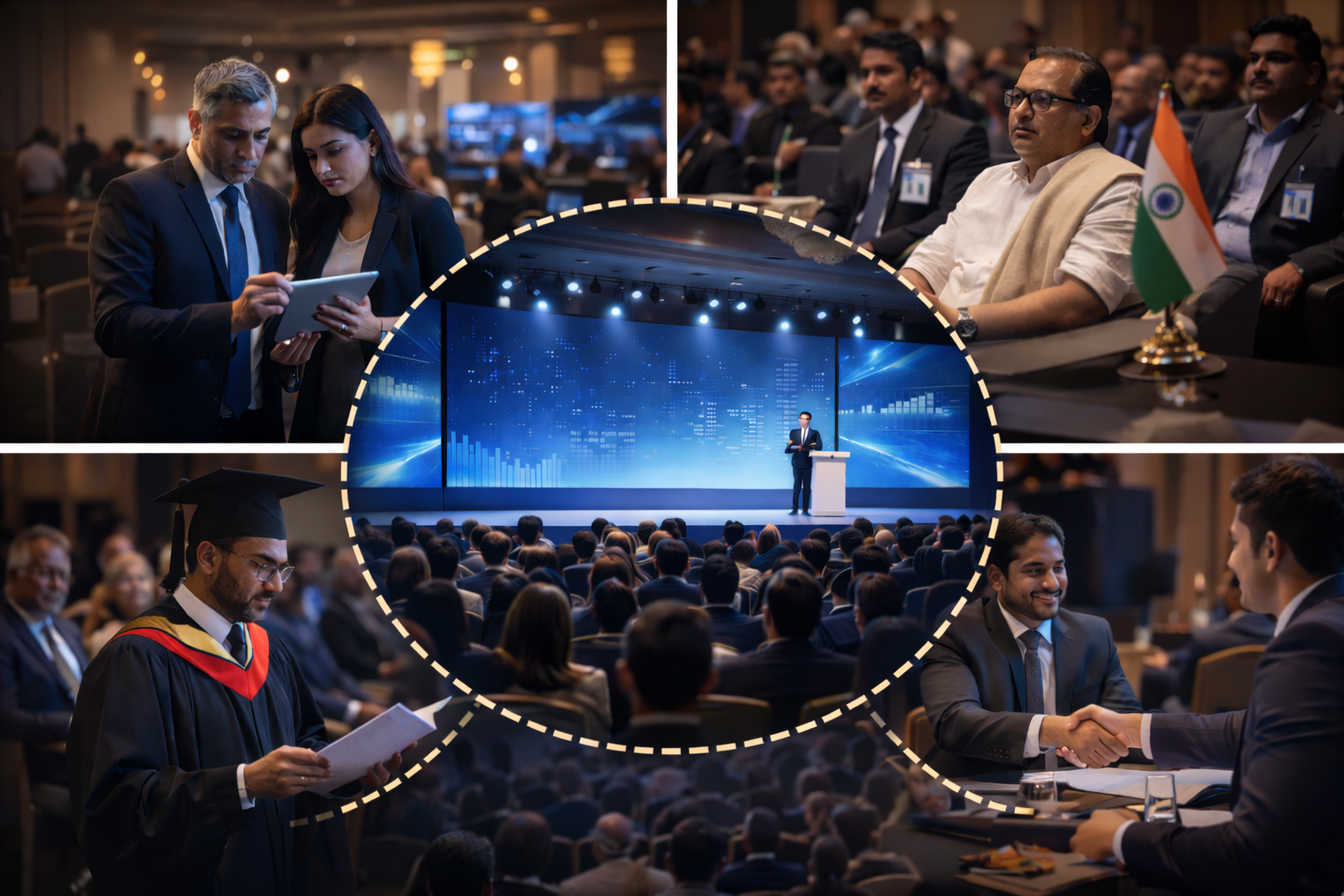
Corporate conferences in Kerala are getting bigger, sharper, and more visible. Kerala Tourism and industry bodies have been actively pushing MICE (Meetings, Incentives, Conferences, Exhibitions) as a serious growth lane, with Kochi repeatedly positioned as a key hub for business events.
That is the good news.
The stressful part is what comes with it: more stakeholders. More protocols. More last-minute approvals. More moving parts that do not follow a neat project plan.
A conference does not become chaotic because people are careless. It becomes chaotic because ownership gets diluted across too many groups.
Why multi-stakeholder conferences break faster in Kerala
Kerala conferences often sit at the intersection of corporate, academic, and public ecosystems. One event can involve leadership teams, academic partners, invited dignitaries, sponsors, and internal departments like HR, admin, and communications.
Each stakeholder has a different idea of “priority.”
Leadership cares about agenda flow and reputation.
Academia cares about schedule integrity, session quality, and formalities aligned to institutional norms.
Government participation can bring protocol expectations around order of proceedings, seating, and inauguration flow.
Sponsors care about visibility and deliverables, often with approvals coming late.
When these expectations collide, coordination becomes the product.
The invisible failure point: “Everyone is coordinating”
In many conferences, multiple people coordinate in parallel. One person speaks to the venue, another to speakers, another to branding, another to hospitality. Everyone is busy, but no one is driving a single version of truth.
That is when small gaps start showing up:
- A session time changes but not everyone updates their run-of-show.
- A VIP arrival detail is assumed, not confirmed.
- A sponsor deliverable is agreed verbally, not locked.
- A technical rehearsal is skipped because “it is standard.”
None of these look fatal. Until event day.
What “calm” conference planning actually looks like
Calm execution is never luck. It is structure.
The core idea is simple: one controlling plan, one escalation path, and one clear decision owner for every critical item. Not ten WhatsApp groups doing ten versions of the same job.
This matters even more in conference venues built for scale, where the operation is spread across halls, breakouts, registration zones, and movement paths. Kerala has venues designed for large conventions and multi-hall formats, especially in Kochi.
Handling government and protocol without creating friction
Government-linked conferences or events with senior dignitaries need a slightly different planning mindset. It is not “extra formality.” It is a different operating system.
Order of proceedings, who inaugurates, stage flow, and security or hospitality arrangements can be governed by protocol expectations. Kerala’s General Administration Department publishes protocol-related orders and guidance that departments refer to.
When protocol is treated casually, the pressure hits late. When it is planned early, it becomes just another controlled track.
Academic partners bring their own rules
Academic stakeholders are usually process-driven. Conference formats, session structuring, approvals, and documentation expectations can be influenced by institutional norms and, in many cases, frameworks tied to bodies like UGC and NAAC.
This does not make planning harder. It makes clarity non-negotiable.
A conference that respects academic workflow tends to run smoother, not slower.
Safety and crowd movement are part of stakeholder planning now
Large conferences are also crowd events. Movement flow, entry and exit, queueing, and risk handling are no longer “venue things.” They are core planning items, especially when attendance is high.
India’s NDMA has detailed guidance around crowd management for mass gatherings, including coordination among organizers, administration, and security agencies. The bigger the event, the more this matters.
The one decision that prevents most chaos
If there is only one decision to make early, it is this:
Who has the final word on changes?
A multi-stakeholder conference will change. Speakers get delayed. Leadership schedules shift. A sponsor requests a swap. A session runs long. The event either absorbs changes quietly or it becomes a visible scramble.
The difference is not effort. It is decision design.
FAQs
Why do corporate conferences in Kerala need more coordination than expected?
Because many events include overlapping stakeholders like leadership, academic partners, sponsors, and sometimes government-linked participants, each with different workflows and expectations.
How early should multi-stakeholder conference planning start?
For a typical corporate conference, 8–12 weeks is a safe baseline. For conferences with protocol, international participation, or heavy academic involvement, starting earlier reduces risk.
What is the biggest coordination mistake in conferences?
Multiple teams operating without a single controlling plan. That creates version confusion and last-minute firefighting.
How should protocol requirements be handled if a government dignitary is involved?
Treat it as a defined planning track from the start, aligned to the relevant protocol guidance and order-of-proceedings expectations.
Do academic partners change how conference agendas should be built?
Often yes. Academic conferences typically expect clearer session formats, structured approvals, and documentation discipline aligned to institutional and funding guidelines.
Why are venues in Kochi frequently used for large conferences?
Kochi has convention-grade venues with multi-hall capacity and large-format event infrastructure suited for business events.
If a corporate conference in Kerala is coming up and multiple stakeholders are already involved, the fastest way to reduce chaos is to lock the coordination structure early. A short call or WhatsApp conversation is usually enough to spot where ownership is unclear and tighten it before event week.
📞 99467 88664 | 94009 91295
✉️ info@theeventpeople.co.in


Add Comment